Learning for efficient intelligence.

Selected papers on physics-guided perception, cross-platform quantization, and Bayesian sparsification.

01 2026

NeurIPS 2026 · Main track · First author

PhysDNet: Physics-Driven Gradient Amplification for Real-Time Image Dehazing

Rayen Dhahri, Lei Sun, Victor Javier Kartsch Morinigo, Alice Pagnoux, Luca Benini, Danda Pani Paudel, Luc Van Gool

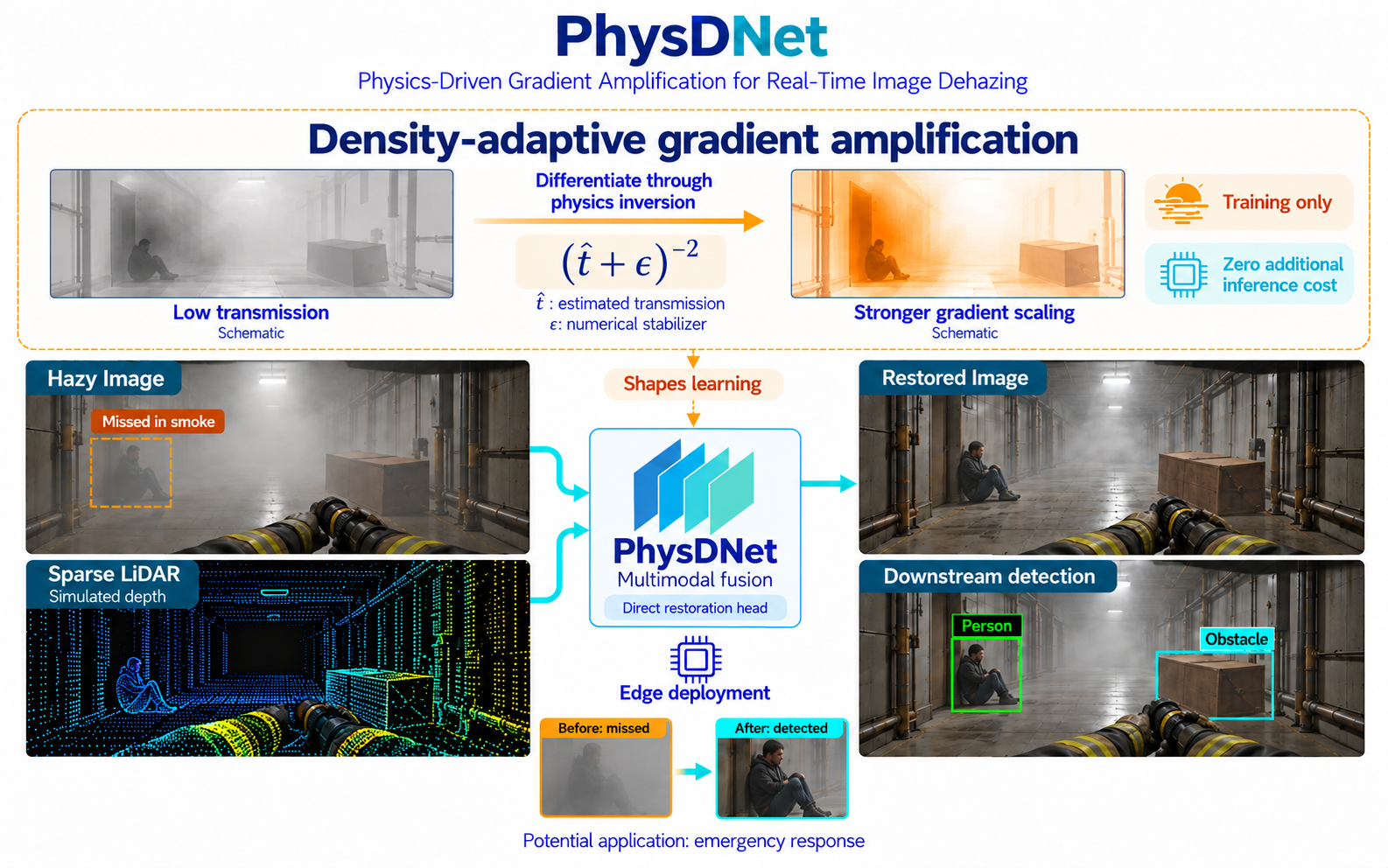
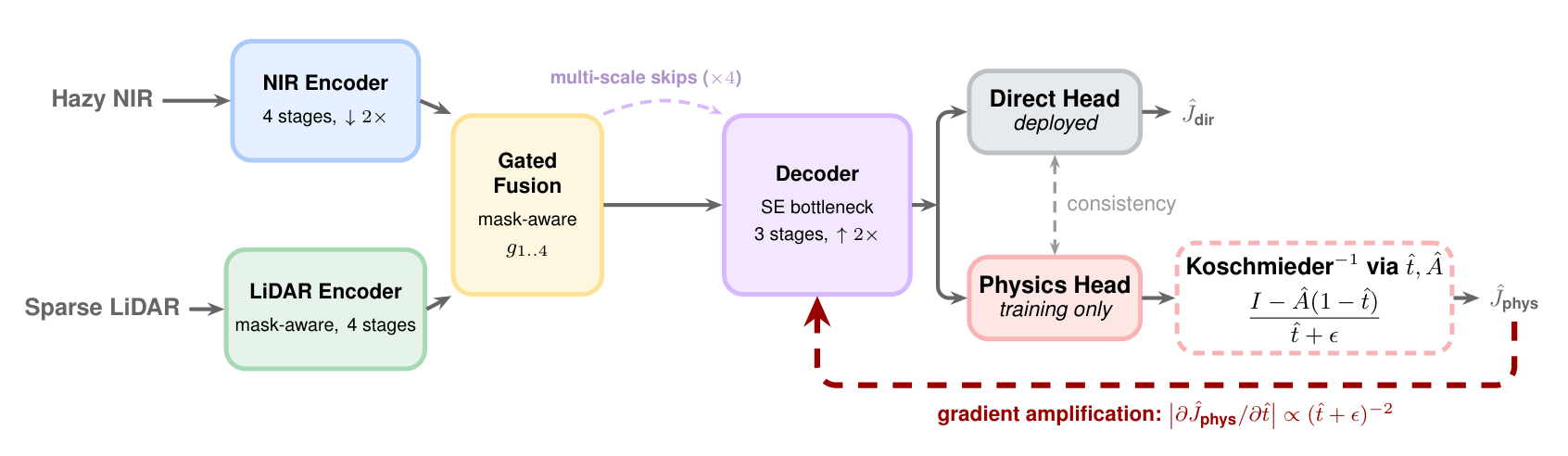
A lightweight network fuses time-gated NIR imagery with sparse LiDAR. A physics-based auxiliary head amplifies gradients in regions of dense haze during training; only the direct restoration head is deployed.

The contribution

Use physical inversion to shape optimization, concentrating learning on degraded pixels while keeping the inference footprint unchanged.

+1.67 dB
PSNR vs. FFA-Net on Seeing Through Fog
5.2× lower
Compute for the reported comparison
29–99 FPS
L/M/S NPU variants, under 4 W
54.9%
Fog-induced detection loss recovered
PhysDNet: density-adaptive gradient amplification during training, multimodal restoration, and an illustrative emergency-response application
Application illustration supplied by the author. Emergency response is a potential application; the reported metrics come from the paper’s benchmark evaluations.
Architecture overview
Dual NIR and LiDAR encoders, mask-aware fusion, a deployed direct head, and a training-only physics head
The physics head affects training. The direct restoration head runs at inference.
02 2025

EurIPS 2025 workshop · First author

Quant-Trim in Practice: Improved Cross-Platform Low-Bit Deployment on Edge NPUs

Rayen Dhahri, Steffen Urban · Carl Zeiss AG

Workshop: Rethinking AI: Efficiency, Frugality, and Sustainability

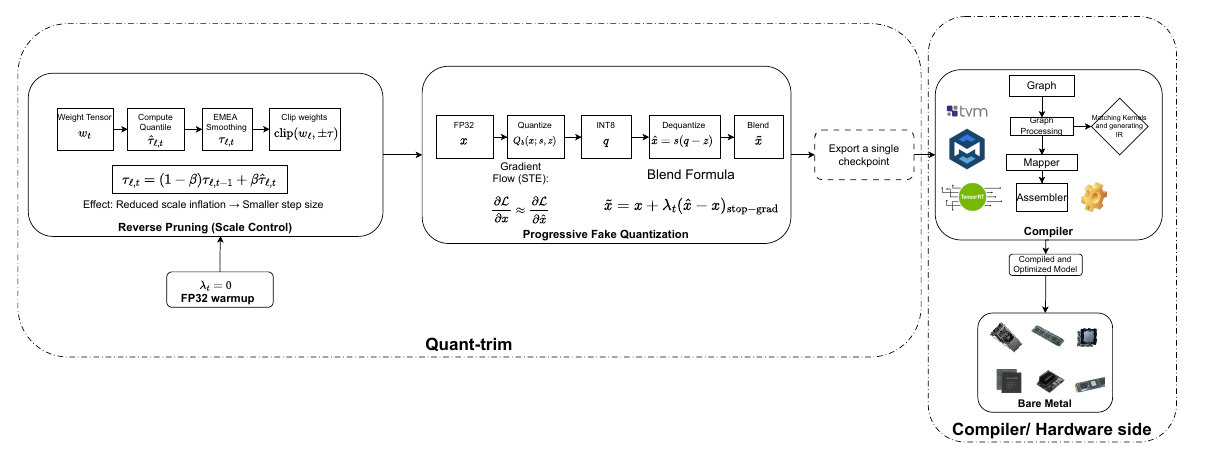
Different edge compilers can turn the same floating-point checkpoint into very different low-bit models. Quant-Trim combines progressive fake quantization with reverse pruning to reduce sensitivity to scaling and clipping choices.

The contribution

A training-time approach to hardware-neutral checkpoints, designed to reduce the need for backend-specific retraining and graph changes.

Original Quant-Trim training pipeline figure from the paper
Figure 1 from Quant-Trim: training-time reverse pruning and progressive fake quantization, followed by standard export.
03 2024

NeurIPS 2024 · Main track · First author

Shaving Weights with Occam’s Razor: Bayesian Sparsification for Neural Networks Using the Marginal Likelihood

Rayen Dhahri, Alexander Immer, Betrand Charpentier, Stephan Günnemann, Vincent Fortuin

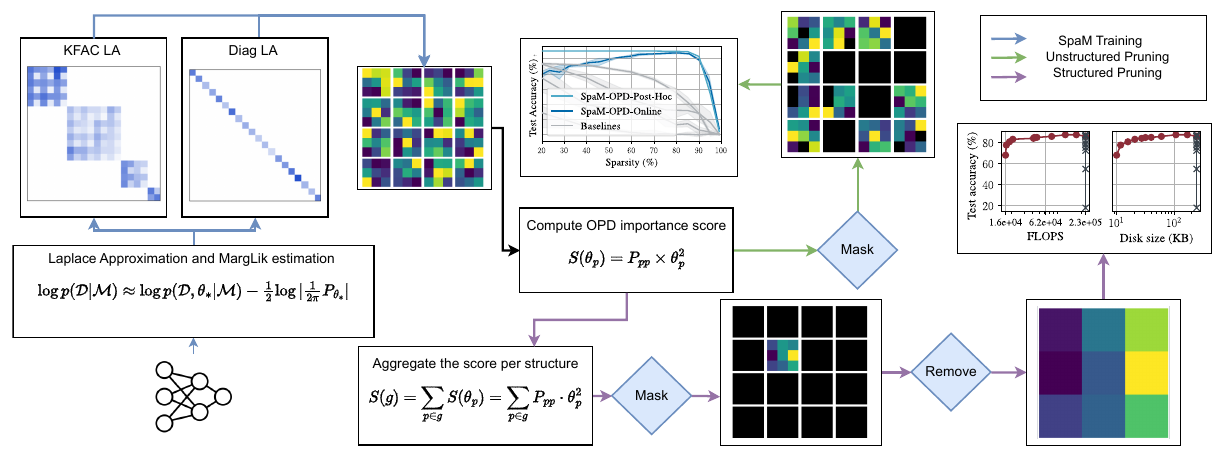
Sparsifiability via the Marginal likelihood (SpaM) uses Bayesian model selection and sparsity-inducing priors to train networks that are easier to prune. The approach supports structured and unstructured sparsification.

The contribution

Improve the model’s capacity to be pruned during training. Reuse the Laplace posterior precision to obtain Optimal Posterior Damage, an inexpensive pruning criterion.

Original SpaM method overview from Shaving Weights with Occam’s Razor
Figure 1 from Shaving Weights: marginal-likelihood training and posterior-based pruning for structured and unstructured sparsification.
04 2022

arXiv preprint · Legal NLP

From Judgement’s Premises Towards Key Points

Key-point extraction from legal judgements, connecting language models and graph-based methods to automated document analysis.

Scientific reviewing

Reviewer for NeurIPS, ICML, ICLR, AAMAS, and JAIR, with interests spanning probabilistic inference, compression, computer vision, and efficient AI.

Research questions. Real-world constraints.

Get in touch about efficient AI, research collaboration, or edge deployment.

Get in touch